
SEO usually takes about six months to show results that matter to a business. The first movement shows up earlier, around month three, but it appears as impressions rather than clicks. Clicks follow, and enquiries come after that. Google's own guidance puts the window at four months to a year, which matches what I see on new sites.
What counts as an SEO result
The question is simple but the word results is doing a lot of work. Three different things get called results, and they do not arrive together.
- Impressions. Your pages are being shown in search. This is the first thing that moves, and it moves before anything else.
- Clicks. People are choosing your result. This follows impressions, usually by a month or two, and it depends on your pages being shown for more of the queries that actually fit them.
- Enquiries and orders. This is the one the business actually cares about. It comes last.
Most disappointment with SEO comes from measuring the third one in month two. At that stage the only honest thing to look at is the first one.
Google has said for years that it takes four months to a year for SEO work to show an effect. That range is wide on purpose, because it depends on how old the site is, how competitive the category is, and how much is published in the meantime. Six months is where most new sites I work on land inside that range.
How long Google says SEO changes take
The wait is not a sales tactic. Google has been fairly open about where the time actually goes.
On Search Off The Record, episode 95, John Mueller was asked how quickly SEO changes show up. His answer separates four cases, and the difference between them is the whole point.
- A small on-page edit. Has to be recrawled and reprocessed, which happens fairly quickly.
- A change to your homepage or one or two pages. Usually reflected in search within a week or two.
- Bigger strategic work across a site. A long time, and how long depends on the size of the site and the scale of the work, because all of it has to be indexed and the rankings recalculated.
- A site starting from virtually no SEO. Often a nice early jump, after which the gains get slower and steadier.
That last case is the one most new businesses are in, and it explains a pattern that confuses people. The early jump is real, but it is the easy part, picked up quickly because there was nothing there before. The slower, steadier phase after it is where the actual position gains happen, and that phase is measured in months.
So the honest answer to "can we speed this up" is partly. The crawling and processing of individual changes is quick. The part where a whole site's worth of new content gets indexed and reassessed is not, and that is the part that decides whether month seven looks different from month one.
What to build in the first six months
The six months is not a waiting period. It is a build period, and what you build decides whether month seven is worth anything.
Which pages are your money pages
Money pages are the pages where the business actually happens. What they are depends on what you sell.
| Business type | Money pages |
|---|---|
| Services or agency | Service pages |
| SaaS product | Feature pages, use case pages |
| E-commerce | Category pages and product pages |
Most new businesses have seven or eight of these. Not seventy. If you cannot name yours in a single sitting, that is the first job, before a word of content gets written.
Why money pages do not rank on their own
A service page or a category page is written to convert. It is short, it is commercial, and on its own it does not answer very much. Search engines have plenty of those already.
What changed recently is worth understanding, because it explains why supporting content matters more now than it used to.
Google describes AI Mode as using a query fan-out technique, which breaks your question down into subtopics and issues a multitude of queries at once on your behalf. The related patent filing, from September 2023, covers using a language model to generate many different queries for a document, so that retrieval works across varied ways of asking the same thing. Everything those queries bring back is pooled into one working set, and the answer is built from that set, at the level of individual passages rather than whole pages.
So the practical effect is this. The more of the territory around your money page you have genuinely covered, the more of those sub-queries you can be retrieved for, and the more passages you have that can be pulled into an answer.
Supporting content is not a ritual. It widens the number of ways you can be found, and it sends internal links to the page you want people to land on.
How many blog posts you need
Here is the model I work to. Treat it as my production capacity, not as a rule.
- 7 to 8 money pages
- About 5 supporting posts around each one
- That is 35 to 40 posts
- At the rate I publish, roughly 4 months of work
Then another two months for that work to settle in the index and start showing up.
One caution. The number is not the point, and publishing volume for its own sake works against you. Five posts that genuinely cover different questions around a money page will do more than fifteen that circle the same one. If you only have the budget for twenty posts, cover four money pages properly rather than eight thinly.
A six month timeline from a real project
One of the projects I work on is a jewellery brand that has been doing business since 1987, but entirely offline. When the online store went live, there was no search presence to build on at all. I handled the SEO on my own: product pages, category pages, blog content, page layout and coordination with the developers.
This is what the six months actually looked like, month by month, straight from Search Console.
| Month | Clicks | Impressions | Avg position |
|---|---|---|---|
| March | 65 | 1,646 | 9.6 |
| April | 99 | 4,040 | 8.4 |
| May | 129 | 6,132 | 9.8 |
| June | 179 | 12,604 | 10.1 |
| July | 426 | 28,313 | 9.6 |
| August | 602 | 52,150 | 9.6 |
March to May looked like nothing was happening. Clicks went from 65 to 129 a month. That is two or three a day. Anyone judging the project at this point would have called it a failure, and the pressure to change direction is real at this stage.
June is where the impressions tell a different story. Clicks only moved from 129 to 179, but impressions doubled from 6,132 to 12,604. The pages were being shown far more often. That gap between impressions and clicks is the earliest honest signal you get, and it showed up months before the clicks did.
July is where clicks finally jumped. From 179 to 426 in a single month, with impressions more than doubling again to 28,313. Nothing new was done in July. This was the earlier work being indexed and reassessed.
August continued it. 602 clicks and 52,150 impressions. Over the six months that is a 9x increase in clicks and a 32x increase in impressions.
Now the part most case studies leave out. Average position barely moved the entire time. It sat between 8.4 and 10.1 from March through August, and it ended roughly where it started. The growth did not come from ranking higher for the same queries. It came from being shown for far more queries. That is what building supporting content around money pages actually does, and it is why impressions are the metric to watch early.
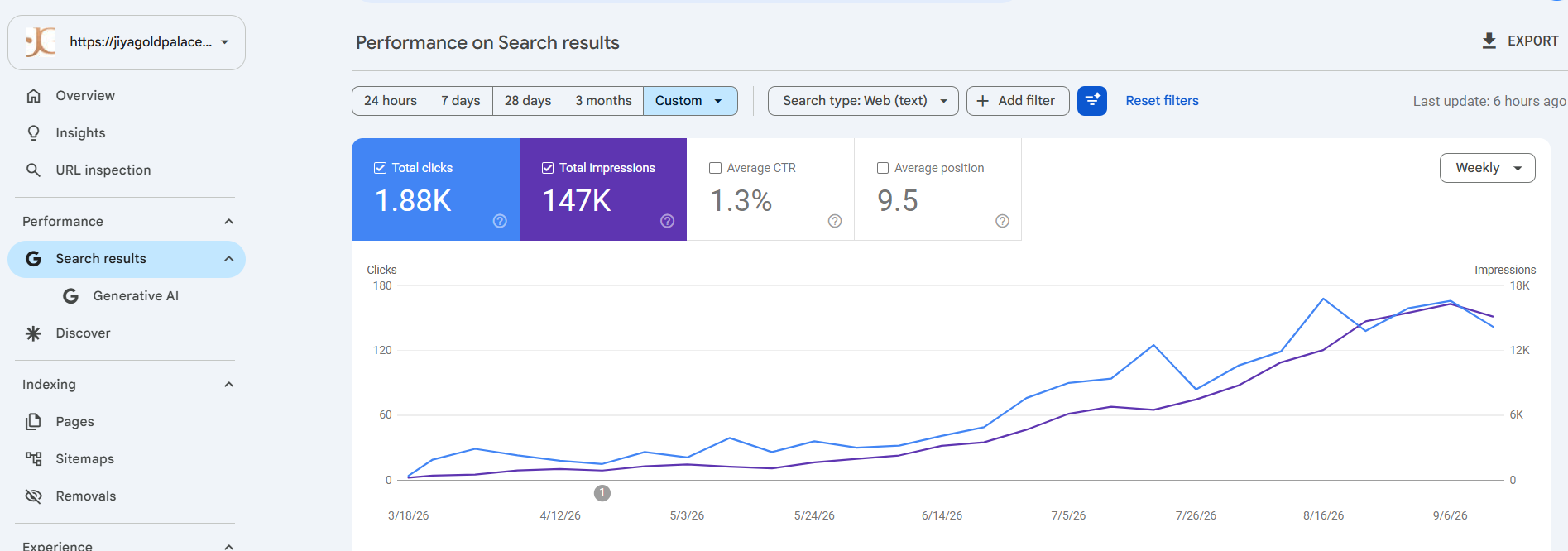
The shape of that curve is the thing to take away, more than the numbers themselves. Flat, flat, a lift, then compounding. A jewellery brand will not have the same numbers as a SaaS product. The shape is what repeats.
Across the full Search Console period, which runs a little either side of those six months, the totals came to 147,000 impressions and 1,880 clicks at an average position of 9.5.
Early results show up in AI search first
This is the part that has changed most, and it is the part worth watching if you are six weeks in and anxious.
Of those 147,000 impressions, about 38,600 came from Google's AI features. That is roughly a quarter of all visibility, on a site that was brand new.
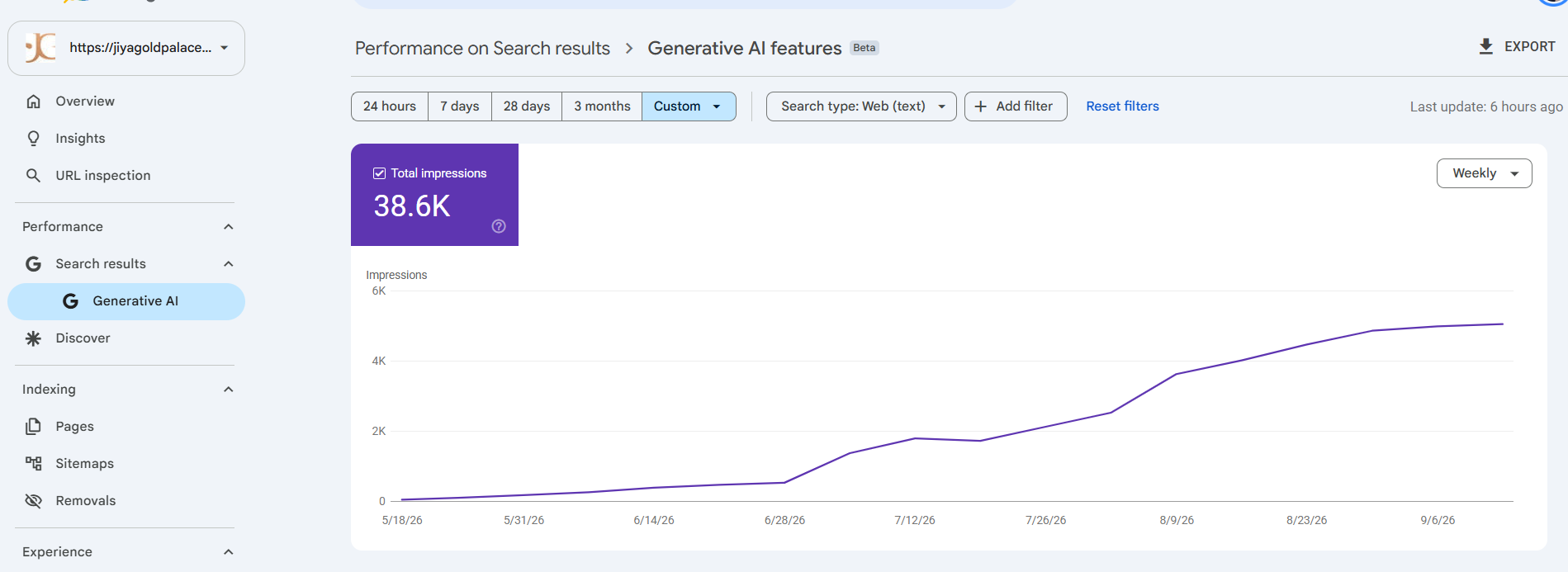
There is a good reason this happens early. Ahrefs looked at 863,000 keywords and 4 million AI Overview URLs and found that only 38% of pages cited in AI Overviews also rank in the top 10 for that query. A year earlier the same study put it at 76%.
In plain terms: you can be quoted in an AI answer while your page is still sitting on page three. Classic rankings and AI citations are no longer the same race, and the second one is easier to get into early.
So if you want an early read on whether your SEO is working, open the Generative AI report in Google Search Console. On a new site it will usually move before anything else does.
One important qualifier, because the opposite claim gets made a lot. This is visibility, not volume. AI assistants such as ChatGPT and Perplexity still send a very small share of actual traffic. SE Ranking measured it at 0.32% of all website traffic across 101,574 sites. Ahrefs put it at 0.35% of tracked referrals, against roughly 30% from search engines.
Both things are true at once. AI features are where your early visibility shows up, and traditional search is still where almost all the clicks come from. Plan for both.
What will not happen in six months
Worth saying plainly, because the answer is more useful than another list of wins.
- Enquiries do not track rankings. Visibility arrives first, enquiries lag it, and the gap can be another two or three months.
- The first enquiries tend to be price sensitive. In my experience the earliest enquiries from a new SEO presence are often the ones comparing on cost. They are still worth taking, and some of them convert later.
- Competitive head terms will not move. On a new domain, in six months, the broad high-volume terms stay out of reach. What moves is the long tail and the specific questions.
- There is no guarantee attached to any of this. Six months of good work makes results likely. It does not make them certain. Category, competition and the site itself all have a say in it.
Why SEO takes longer than six months for some sites
When a project runs past the window, it is usually one of these four.
- The site was rebuilt or migrated halfway through. A redesign in month three resets a good part of the clock. If a rebuild is coming, do it before the SEO work starts, not during.
- Money pages were never defined. Content gets published, but it points at nothing in particular. There is no page for the visibility to collect around.
- Publishing happened in bursts. Twenty posts in one week and nothing for two months works less well than a steady few each week, because a site's content has to be indexed and reassessed as a whole.
- The money pages themselves are thin. Supporting content cannot rescue a category page with one line of text and no reason to exist. Fix the destination before building the roads to it.
A month by month SEO plan
| When | What you do | What you check |
|---|---|---|
| Month 1 | Name the money pages. Write them properly. Fix indexing and basic technical issues. | Pages indexed |
| Months 1 to 4 | Publish supporting content steadily around each money page. Link it back. | Pages published, pages indexed |
| Month 3 | First review point | Impressions, and the Generative AI report. Not clicks. |
| Months 4 to 6 | Keep publishing. Start improving the pages that are being shown but not clicked. | Impressions, average position |
| Month 6 | Second review point | Clicks, average position, AI feature impressions |
The review points matter as much as the work. Checking clicks in month two tells you nothing and usually leads to abandoning something that was about to work.
Summary
Six months is a fair expectation, and most of that time is spent building rather than waiting. Name your money pages, cover the ground around them properly, publish steadily, and check impressions before you check clicks. The curve stays flat for longer than feels comfortable, and then it does not.
If you want to see what that looks like with the actual numbers, the full numbers are on my portfolio page. On whether the supporting content is still worth writing at all, I have covered that in do you still need a blog in 2026.
Frequently asked questions
How long does SEO take for a brand new website?
About six months to results that matter, with the first visible movement around month three. Google's own guidance is four months to a year. A brand new domain sits at the slower end of that range, because there is no history for search engines to draw on yet.
Can SEO show results in 3 months?
It can show early signs. Impressions will usually be climbing and some long tail pages will be getting shown. What it will not show in three months is a meaningful number of enquiries. If three months is all the runway you have, consider paid search alongside it.
How many blog posts do I need before SEO works?
There is no fixed number. A useful way to plan it is five or so genuinely different supporting posts around each money page you want to rank. For a business with seven or eight money pages, that comes to 35 to 40 posts.
Does AI search show results faster than Google rankings?
Often, yes. Ahrefs found that only 38% of pages cited in AI Overviews also rank in the top 10 for the same query. So a page can be quoted in an AI answer before it ranks well. Check the Generative AI report in Search Console for this.
How do I know SEO is working before I get traffic?
Watch impressions rather than clicks, and watch whether average position is improving even while it is still poor. A page moving from position 45 to position 18 has made real progress, and it will show up in Search Console long before it shows up in your enquiries.
Sources
- Google on how long it takes for SEO to work, Search Off The Record episode 95
- Google on AI Mode and the query fan-out technique
- Systems and methods for prompt-based query generation for diverse retrieval, WO2024064249A1
- How AI Mode and AI Overviews work, based on Google's patent filings
- Ahrefs study on AI Overview citations and top 10 rankings
- AI referral traffic benchmarks, SE Ranking and Ahrefs data